
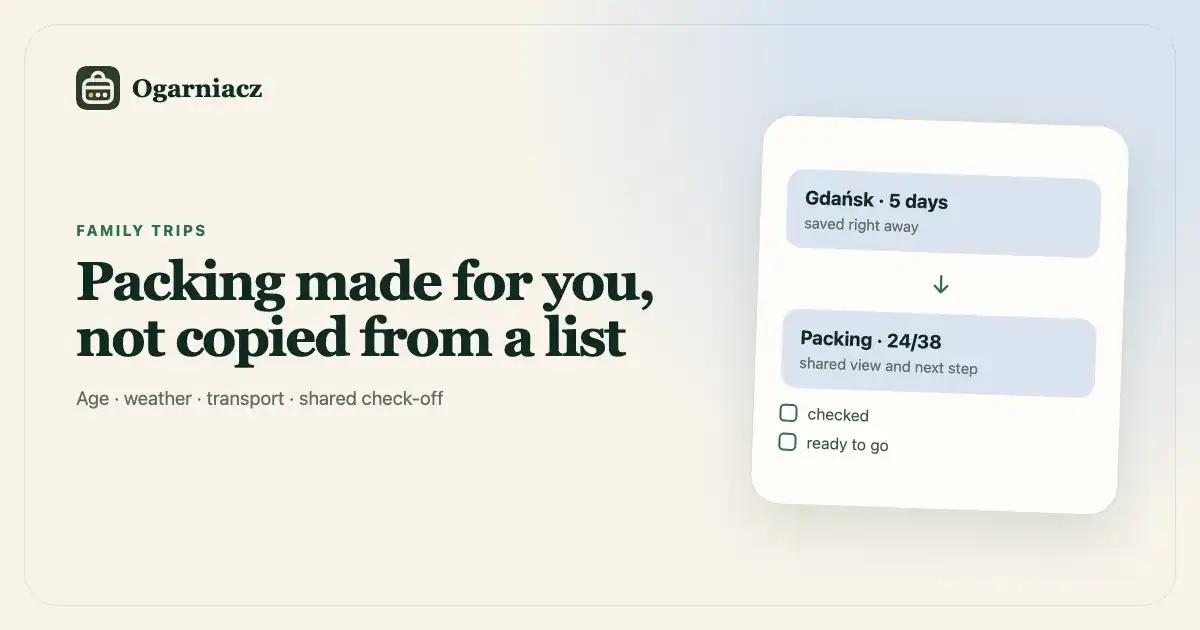
Every parent knows the sentence uttered several minutes after leaving: "Did you take a charger? And a cuddly toy?" Packing with a baby involves many small decisions. A universal list helps, but it shouldn't be a blind set of 100 points.
There's a different way to pack a baby for a weekend with grandparents, an eight-year-old for a plane, and a family for a winter trip by car. Therefore, the checklist below is a base for adjustments, not an order to take everything.
Before you start: five list-changing facts
- Age and needs of each participant.
- Number of days and laundry facilities at your destination.
- Weather at stages of the route and at your destination.
- Transport: car, train, plane, bicycle.
- Accommodation equipment: towels, cot, kitchen, washing machine and high chair.
Also write down the things that are mandatory for your family - a medicine you take on a regular basis, a hearing aid, a favorite item for falling asleep. A good packing app should remember these items for subsequent trips.
Documents and formal matters
- a valid ID card or passport of the child, depending on the destination,
- tickets, reservations and accommodation details also available offline,
- an EHIC card for each eligible person for travel to countries covered by the system or appropriate insurance,
- consent required in a given country or by the carrier for the child's travel,
- contact to the insurer, medical provider and emergency contact,
- small cash and a payment card.
Requirements may depend on country, transport provider and family circumstances. Before traveling abroad, check the current rules in official sources: information about the child's trip abroad and rules and application for the EHIC in the National Health Fund. Consent to issuing a document is not the same as consent to a specific trip.
Clothing: a list to adjust
- underwear and socks for every day plus a reasonable supply,
- T-shirts or bodysuits,
- trousers, shorts or skirts,
- sweatshirt or sweater,
- pajamas,
- jacket adapted to the weather,
- basic and spare footwear,
- headgear,
- a bag for dirty or wet clothes,
- one set easily available in hand luggage.
Instead of a rigid rule of "eight items in seven days", take into account washability, the child's stage of development and the type of activity. For a small child, the supply may be larger; with a washing machine on site - smaller.
Medicines and first aid kit
- medicines taken constantly in sufficient quantities, along with instructions and necessary documents,
- thermometer,
- basic dressing materials and a means for cleaning minor wounds,
- preparations recommended to the child by a doctor or pharmacist,
- sun and insect protection suited to the child’s age and destination,
- allergy details and important contact numbers.
The list is not medical advice. Do not choose a drug or dose based solely on an online checklist. In case of chronic diseases, traveling in special conditions or if you have any doubts, consult the kit with your doctor or pharmacist. Store medicines according to the leaflet and out of the reach of children.
Hygiene and care
- toothbrush and toothpaste,
- everyday cosmetics in small packages,
- dry and wet wipes,
- diapers and care products, if needed,
- a travel potty or an overlay, if the child uses them,
- a towel if the accommodation does not provide it,
- a brush, rubber bands, clips and other everyday items.
Travel and hand luggage
- water and snacks appropriate to the length of the trip,
- tissues and bags for emergencies,
- spare clothes for the child, and in the case of a small child, also a T-shirt for the caregiver,
- favorite cuddly toy or thing to fall asleep to,
- a book, stickers, a radio play or other quiet entertainment,
- headphones, chargers and powerbank,
- you need a car seat, stroller or carrier,
- things necessary during a transfer, delay or waiting for luggage.
Keep the most important documents, medicines and irreplaceable items with you, not only in your checked luggage.
Summer variant
- swimsuit and beach towel,
- UV T-shirt, headgear and glasses,
- appropriate sun protection,
- water shoes, if the terrain requires it,
- a light layer for a cold evening,
- a water bottle and a small backpack,
- water equipment adapted to the skills and supervision of adults.
Winter variant
- layered clothing and thermal underwear,
- waterproof jacket and trousers,
- at least two pairs of gloves,
- hat, scarf and warm socks,
- appropriate shoes and a change of footwear,
- helmet and equipment adapted to the activity,
- protective cream selected for the conditions.
Things depending on age
Baby or toddler
A supply of food and feeding supplies, diapers, a changing table, transportation, sleep items, and more changes of clothes.
Preschooler
An easily accessible set of clothes, a cuddly toy, simple entertainment, a night guard if used, and a small backpack.
School child
Own hand luggage with water and entertainment, charger, document, items related to planned activities and part of the list for which he or she can be responsible.
Three-pass packaging system
1. Check and shop - a few days in advance
View the entire list. Mark items to wash, borrow or buy. In Ogarniacz, missing items from packing can be transferred in bulk to a common shopping list.
2. Packing - the day before
Divide the categories among caregivers, but check them off on one list. Then there are no two separate "I think it's already packed" versions.
3. Final check - before leaving
Check the short critical list: documents, medications, phone, keys, wallet, hand luggage and the child's mandatory belongings. This is not the time to read a hundred items from the beginning.
How does Ogarniacz tailor packing for a trip?
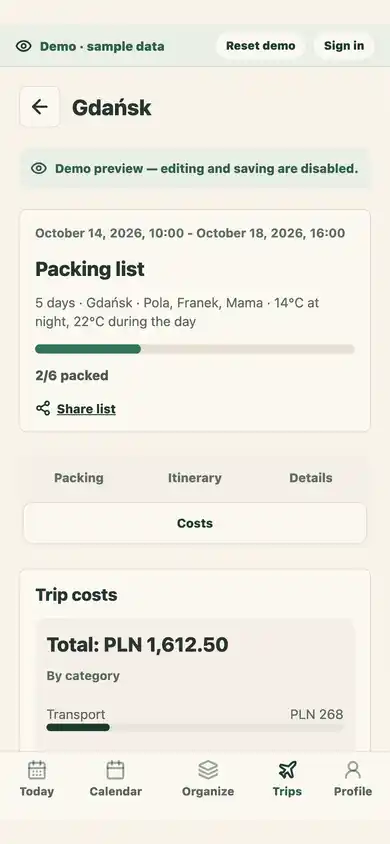
The trip has dates and times, participants, transport and route stages. Based on this, AI assistance can propose a plan and packing list tailored to age, weather and travel method. For close dates, the application uses a forecast, and for later dates it displays an estimate that needs to be refreshed later. On the first step, save the destination, exact accommodation address, and arrival/departure dates and times. This keeps the packing list unchanged; review and approve packing suggestions with a separate action. When refreshing the itinerary, choose places to include or skip. If only one day needs a change, ask for an alternative for that day; the rest of the itinerary and packing list stay unchanged. The itinerary uses the accommodation address and travel times, so a late arrival or early departure should not fill an entire day.
You can also track actual costs in the trip details. Add them manually or extract several expenses at once from a statement image or text-based PDF. Review, correct, or remove each item before saving. Possible duplicates with the same date, amount, and currency are marked and excluded by default; then see totals by category and currency. Source files are not kept.
For the full process, read how to import a PDF statement and organize trip costs.
You can add permanent must-have items, provide feedback on suggestions, check off entire groups and move "to buy" items to your shopping list. Suggestion is the starting point - ultimate responsibility for documents, medications and safety remains with the caregiver.
A list that learns your way of travelling
When you return, take two minutes to ask three questions:
- what was missing,
- what went wrong,
- which should always appear with this type of trip.
Add permanent mandatory items and remove unnecessary ones. The next time you go, you don't start with a general checklist from the Internet, but with a database that is closer and closer to your family's needs.